

For many Singaporeans, property is more than just a home, it is one of the biggest financial assets they will ever own. Whether you are planning to upgrade to a condominium, downgrade after your children move out, invest in another property, or purchase a new BTO, timing plays a crucial role in your financial flexibility.
One of the most overlooked milestones in property planning is turning 55 years old.
While many homeowners understand that CPF plays a role in financing their home, few fully appreciate how their CPF changes after they reach 55 and how these changes can significantly impact their future property decisions.
If you intend to buy, sell, upgrade, or restructure your property portfolio, understanding what happens at age 55 could save you from unexpected financial constraints.
What Happens to Your CPF at Age 55?
When you turn 55, the CPF Board automatically creates your Retirement Account (RA).
The Retirement Account is designed to set aside savings for your retirement. CPF will transfer money from your Special Account first, followed by your Ordinary Account, to build up your Retirement Account up to the applicable Full Retirement Sum (FRS) if you have sufficient CPF savings.
This process is meant to ensure that every Singaporean has adequate retirement savings that can eventually provide monthly payouts during retirement.
From a retirement planning perspective, this is an excellent policy. However, from a property planning perspective, it introduces an important consideration that many homeowners are unaware of.
Why Does This Matter When Selling Your Property?
Many homeowners use their CPF Ordinary Account (OA) to finance their property purchase.
Over the years, CPF savings are withdrawn to pay for:
- Down payments
- Monthly mortgage instalments
- Legal fees
- Stamp duties
- Other eligible housing expenses
When the property is eventually sold, all CPF monies used, together with the accrued interest, must be refunded back to CPF.
This is where age becomes extremely important.
Selling Property Before Age 55
If you sell your property before turning 55, the CPF monies refunded from the sale, including accrued interest, are generally returned to your CPF Ordinary Account.
This means the refunded CPF savings remain available for future housing purchases, subject to CPF housing rules.
For example:
You sell your HDB flat at age 50.
After the sale, the CPF used for the property and the accrued interest are refunded into your Ordinary Account.
You can then utilise these CPF funds again to purchase another property, whether it is another HDB flat, an Executive Condominium, or a private property (subject to eligibility and prevailing regulations).
This gives you significantly greater flexibility when planning your next property purchase.
If You Sell Your Property After Age 55
The situation changes once you are 55 years old or older.
If your Retirement Account has not yet met the Full Retirement Sum, CPF refunds from your property sale may first be directed towards topping up your Retirement Account.
Instead of the refunded CPF returning entirely to your Ordinary Account, part or even a substantial portion may be transferred into your Retirement Account until the applicable retirement sum is met.
Because funds in the Retirement Account are meant for retirement, they generally cannot be reused for purchasing another property, except under specific CPF rules and conditions.
This means you may suddenly discover that a significant amount of CPF savings you expected to use for your next home purchase is no longer available.
Example Selling Property Before Age 55 vs After Age 55
Imagine two homeowners with identical financial situations.
Both purchased an HDB flat many years ago using CPF.
Both decide to sell their flats today and buy a condominium.
Homeowner A: Age 53
After selling the flat all of the CPF that are stored in the property will be refunded back into the Ordinary Account, which can be used for your next property or condominium purchase. When you are able to use the CPF funds, you will require less cash upfront and it will help with the financing of your next property.
Homeowner B: Age 57
After selling the flat similarly, all the CPF that are stored in the property will be refunded back into the PF account. However, it will not automatically go into the Ordinary Account. Firstly, CPF will see if your Retirement Account has reached it's full retirement sum. If your retirement account has not reached the full retirement sum, the amount that is refunded back into the CPF account will be first used to top up the retirement account to it's full retirement sum, only the remaining CPF after topping up to the full retirement sum will go back into your ordinary account.
As a result, this homeowner now has considerably less CPF available to finance the next purchase.
To proceed with buying the condominium, they may need substantially more cash than expected.
If you want to know how much you can afford comfortably it is best to contact me for a property financial analysis.
How Does Property Loan Work After 55
Many people assume they can simply borrow more from the bank if they lack CPF funds.
Unfortunately, financing becomes more challenging as we age.
Banks calculate home loans based on several factors, including:
- Age
- Income
- Loan tenure
- Total Debt Servicing Ratio (TDSR)
- Loan-to-Value (LTV) limits
As you grow older, the maximum loan tenure shortens.
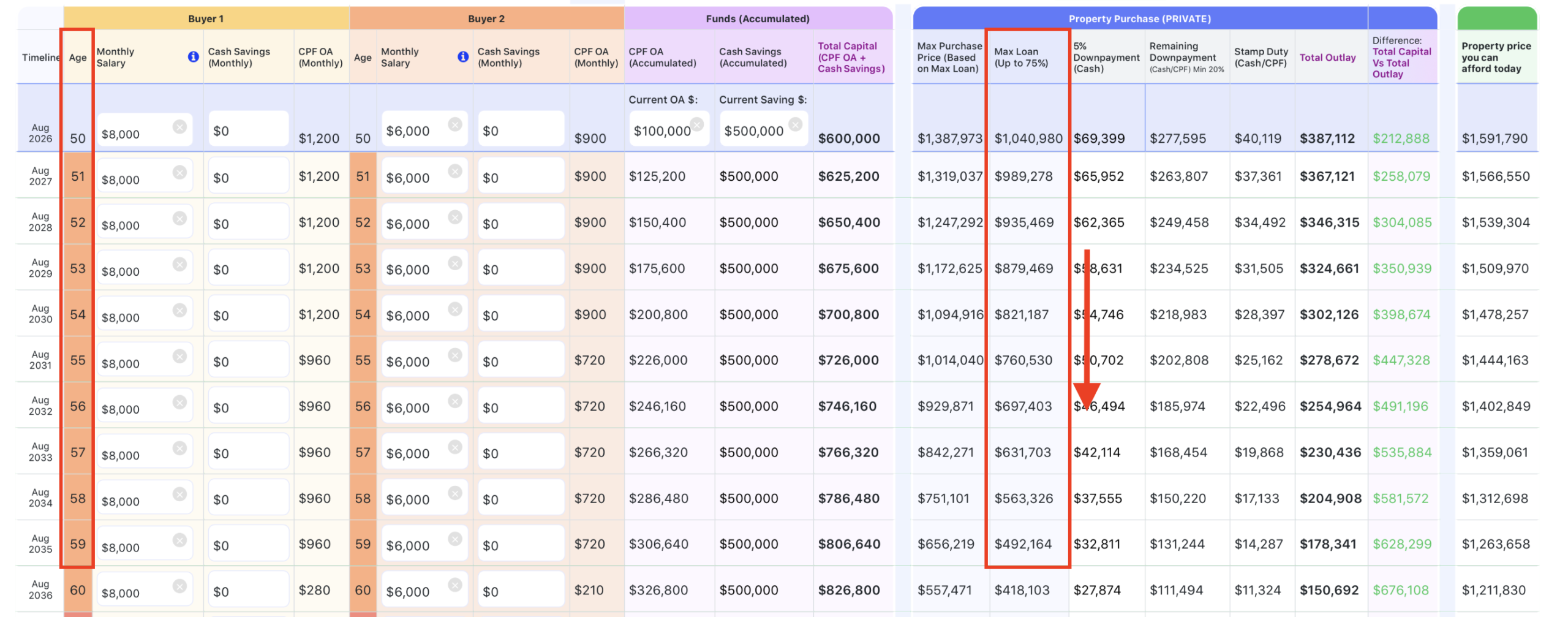
Looking at the calculation table, at age 50 you are able to have a maximum loan of $1.04 Million. At age 55, your maximum loan reduces to only $760k.
A shorter loan tenure generally results in:
- Lower maximum loan amounts
- Higher monthly instalments
- Greater cash commitments as shortfall has to be topped up with cash
This means that at exactly the stage when your CPF available for housing may be reduced, your borrowing capacity may also decline.
These two factors combined can significantly affect your purchasing power.
Property planning requires time, knowing your affordability at different stages of your life is important so that when an opportunity arises you can act on it confidently!
The Hidden Impact on Property Choices When Selling After 55 years old
Many homeowners only discover this issue after selling their existing property. Selling your property is not as straightforward as it gets once you are at an older age because there will be a restriction when taking a loan. Even though your salary might be higher, as you have lesser loan tenure, the amount of loan will decrease significantly.
Also, your CPF retirement account, if it is not at the full retirement sum, then sales proceeds, which are supposed to return to the CPF ordinary account will be used to top up the CPF retirement account to it's full retirement sum.
With a lower loan and lower sales proceeds. It means that you will need to come up with a larger cash downpayment as compared to someone that is below age 55, who is able to get a higher property loan and also able to fully utilise their CPF sales proceed.
You might think that you can upgrade any time you want, but this is the hidden or rather overlooked area when it comes to property upgrading.
Some may have intended to upgrade to a larger condominium but now have to settle for a smaller unit.
Others may have planned to buy near their children but find themselves priced out.
Some may even postpone purchasing another property simply because they no longer have sufficient CPF available.
All of these situations can often be avoided with proper planning before reaching age 55.
This Doesn’t Only Affect Upgraders
Many people think this only concerns homeowners upgrading from HDB to private property.
But in reality once your home affordability is being reduced, it will affect all areas of property planning.
You might be planning to downgrade or right-size to unlock some equity that has been stored in your property. However, if CPF is going to lock up some of your sales proceeds, then it would mean that you will be getting lesser cash proceeds.
Even if you are not upgrading, you might just be trying to change to another resale HDB due to personal reasons, like staying closer to children or family members. As such if the HDB is of the same price as your current flat, you might not be able to afford it. Shifting house is not just seeing the price of the house. There are other cost involved that you must take into consideration.
Let's say you want to buy a BTO as your current HDB is of a certain age, it doesn't mean that if the BTO is the same price as your current HDB, you will be able to afford it. You must take into account that if you are above age 55, you will need to return the amount of CPF used including accrued interest to top up your retirement fund to the full retirement sum. Let's not forget that you will also need to pay resale levy and you will need to pay buyer stamp duty as well.
In each of these situations, having access to your CPF Ordinary Account before age 55 can make a substantial difference.
Planning Ahead Makes a Big Difference
Property planning should never happen only when you are ready to sell.
Ideally, homeowners should begin reviewing their plans several years before turning 55.
Questions worth considering include:
- Do I intend to upgrade?
- Will I eventually downgrade?
- Should I move closer to my children?
- Will I need a retirement home?
- Do I plan to invest in another property?
- How much CPF have I used for my current property?
- Has my Retirement Account reached the Full Retirement Sum?
- Will I still qualify for the loan I need in five years?
The earlier these questions are addressed, the more options remain available.
Don’t Wait Until It’s Too Late
One of the biggest mistakes homeowners make is assuming they can always make property decisions later.
Unfortunately, age changes both CPF rules and financing options.
What is financially possible at age 52 may become significantly more challenging at age 56.
This does not mean you cannot buy property after turning 55.
Many Singaporeans continue to purchase homes successfully after 55.
However, the financial planning required becomes much more important because your CPF usage and loan eligibility may no longer be as flexible as they were during your younger years.
Knowledge Gives You More Choices
The goal is not to create urgency for the sake of it, but to encourage homeowners to make informed decisions.
Understanding how CPF works after age 55 allows you to plan ahead instead of reacting when circumstances force your hand.
For many homeowners, acting before age 55 could mean:
- Having more CPF available for the next purchase.
- Requiring less cash upfront.
- Enjoying greater loan flexibility.
- Preserving more property options.
- Executing an upgrade or downgrade according to your long-term goals rather than financial constraints.
Final Thoughts
Age 55 is a significant financial milestone in Singapore not only because of retirement planning but also because it can directly influence your property journey.
If you are considering selling your HDB, upgrading to a condominium, downsizing for retirement, purchasing a BTO, or making any major property move in the coming years, it is worth reviewing your plans well before your 55th birthday.
Many homeowners only learn about the impact of CPF Retirement Account top-ups after they have sold their property, by which point their available CPF funds for the next purchase may already be reduced. Coupled with potentially lower loan eligibility due to age, this can limit the range of homes they are able to afford.
The key takeaway is simple. Plan early, understand how CPF rules affect your situation, and make property decisions with the long term in mind. By doing so, you give yourself the greatest flexibility and the widest range of options for your next home.
Property planning should not be done, only when you have an urgency to sell, because at that point of time you will be left with no choices. This would mean that your options will be limited. Often, when I run the numbers with clients, it is often the case where their finances or situation do not allow them to act on anything. However, they are aware of what they can do in future and this gives them an idea of what they need to look out for.
Give me a call today and let me answer your Property questions and also run through your finances today. There is absolutely no obligation, and you can ghost me anytime you want. Therefore if you want to know more about what you can, or cannot do in the present or in future, then click here to contact me now!
Disclaimer: This article is intended for general educational purposes only and does not constitute financial or legal advice. CPF rules and housing regulations may change over time, and individual circumstances differ.